
Managing and Continuously Improving Your Cybersecurity Posture
Cybersecurity is not a program you complete. It is a management discipline you maintain. Organizations that treat it as a project tend to improve their posture for a period and then watch it degrade as the business moves on. The controls they deployed stop keeping pace with how the business actually operates, and the risks they modeled no longer reflect the threats they face.
Posture management is the structured practice of measuring your security effectiveness, acting on what you find, and keeping that cycle running as your organization evolves.
- Cybersecurity posture is not a one-time project. As your business evolves, your risk exposure changes continuously, making regular assessment and improvement essential.
- Effective cybersecurity management requires more than technical metrics. Organizations need to translate security performance into business risk and financial exposure to support informed decision-making.
- The strongest security postures are built through a continuous cycle of assessment, prioritization, action, and review, ensuring security investments remain aligned with business realities and emerging threats.
Understanding Your Cybersecurity Posture
Your risk exposure changes with the business
Your cybersecurity posture is the combined effectiveness of your security controls, governance processes, employee awareness, and resilience capabilities, measured against your actual risk exposure at a given point in time.
When your operating environment changes so does your risk profile. A new SaaS platform, a supplier given access to your systems, a team that has moved to permanent remote work — each one extends your attack surface and may introduce gaps that existing controls do not cover. Your posture is continually changing, even if you have not changed a single security tool.
Why an unmanaged posture drifts over time
Security controls degrade in two ways: through active change and through passive drift. Active change is straightforward — a new cloud environment is deployed, and the security configuration does not follow. Passive drift is more insidious: controls remain in place but stop being effective as the context around them shifts.
Without a regular risk management cycle, drift will lead to gaps in your security strategy. As a result of the changing risk landscape and your evolving business context, your posture is constantly changing whether you manage it or not.
The Specific Challenges Facing SMEs and Mid-Sized Companies
Visibility without a dedicated security team
In a large enterprise, a security operations team monitors controls continuously, produces regular reporting, and owns the improvement roadmap. In an SME, security is typically one responsibility among many for an IT manager or an outsourced provider. The result is that nobody has a complete view of the organization's security performance across all domains simultaneously.
When IT responsibilities are distributed across an internal manager, a managed service provider, and one or more cloud platforms, each party has visibility into their own piece of the environment. Your MSP knows the endpoint status. Your cloud provider manages infrastructure security. Your internal IT contact handles the rest. But the complete, consolidated view of your security posture across all domains, at any given moment, exists nowhere.
Turning technical data into business decisions
Security tools produce technical output: patch status, alert volumes, vulnerability scores, log data. That output is essential for the people managing security day-to-day, but it does not answer the questions that matter to a CEO or CFO: what is our actual financial exposure if we have an incident? Are we more or less exposed than we were six months ago? Is our security investment reducing risk in any measurable way?
When IT responsibilities are fragmented across providers, there is no natural owner for translating that technical data into business risk terms. Boards approve budgets without understanding what the money achieves. IT teams implement controls without knowing which risks they are actually reducing. Translating security performance into financial risk terms closes that gap and makes every investment decision defensible.
Measuring and Managing What Matters
Start with a regular cyber risk assessment
The foundation of any measurement framework is a regular cyber risk assessment. Without it, your dashboard has no objective baseline to measure against, no way to track whether remediation actions are closing real gaps, and no financially quantified figures to bring to a governance conversation.
A structured assessment, run at least twice a year, produces three things: a current picture of your control maturity across all domains, a quantified view of your financial exposure under likely attack scenarios, and a gap analysis that feeds directly into your prioritization decisions. It also captures how your risk profile is changing as the business evolves and the threat landscape shifts. Everything in your measurement framework flows from that process.
Performance Metrics vs. Risk Metrics
A security dashboard serves one purpose: giving decision-makers the information they need to act. That requires two distinct types of metrics working together.
Performance metrics measure execution quality: whether the controls you have in place are operating as intended. Patch compliance rate, MFA coverage across user accounts, mean time to detect a security event, phishing simulation results, and backup recovery test success rate all fall into this category.
Risk metrics measure business impact: what your current control performance means in terms of financial exposure and operational vulnerability. Estimated incident cost under your most likely attack scenario, control maturity scores benchmarked against your sector, and risk exposure trends over time give leadership the objective, business-level view they need to apply governance oversight effectively.
For the data to be useful for decisions, both types should be tracked and compared at each assessment cycle.
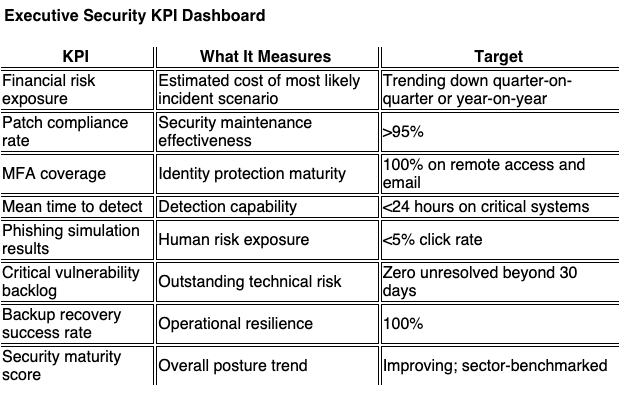
This data should be adapted depending on the audience. At the executive level, quarterly reporting covers financial risk exposure, posture trend, and investment priorities — one page, business context, financial metrics. Management receives monthly KPI trends, action plan status, and any risks requiring budget decisions. The security team works from a continuous view of vulnerability status, open alerts, and patch queues.
The Continuous Cyber Risk Management Cycle
A resilient security posture requires continuous oversight
Cyber threats evolve continuously, business systems change, and regulatory expectations are updated regularly. A security assessment completed six months ago already reflects a different reality than the one you operate in today. This is why leading frameworks treat cyber risk management as an ongoing iterative process rather than a periodic event. NIST explicitly recommends this approach. EBIOS RM, the methodology developed by ANSSI and referenced by ENISA, goes further — it defines two distinct review cycles because the threat landscape and business context change at different speeds: a strategic cycle that revisits the full risk picture, and an operational cycle that responds to new incidents, vulnerabilities, and shifts in attack methods.
The organizations that maintain the strongest security postures are not necessarily the ones that invest the most. They are the ones that review and update their security priorities on a regular cadence, responding to changes in their business context, their control environment, their compliance obligations, and the threat landscape. That cadence is also what builds demonstrable resilience — the kind that regulators, insurers, and business partners can assess and verify. A documented, repeatable improvement cycle is the difference between claiming your organization is secure and being able to prove it.
Starting and Sustaining the Cycle
Assess. At minimum, conduct a structured review of your cyber hygiene, control maturity, financial risk exposure, regulatory alignment, and the current threat landscape for your sector. An external quantitative cyber assessment is particularly valuable as it does not require an internal team and provides an objective benchmark.
Prioritize. Assessments identify more gaps than you have the capacity to address at the same time. A quantitative approach guides prioritization based on risk reduction: which controls, if implemented, would most reduce your financial exposure? Which regulatory gaps carry the highest penalty risk? Decisions made on that basis are both more defensible and more effective than those made by working through a generic control framework top to bottom.
Act. A risk-based action plan does more than guide your internal priorities. When your remediation decisions are grounded in quantified risk reduction, they are defensible to the people who will scrutinize them: regulators assessing your compliance posture, insurers evaluating your coverage terms, and partners who need confidence in your operational resilience. Each action needs a named owner, a deadline, and a clear link to the risk it addresses. That traceability is what turns a to-do list into a governance document.
Review. Each assessment cycle should produce a direct comparison against the prior period. The question is not just whether actions were completed, but whether completing them moved your risk posture in a measurable direction. EBIOS RM frames this as a residual risk evaluation: after each cycle, the remaining risk is assessed against an acceptable threshold. Where it falls short, the next cycle's priorities are updated to reflect it. The Review stage feeds directly back into the next Assess, incorporating what was learned into updated priorities and a revised action plan.
A semi-annual external assessment, or quarterly for higher-risk organizations, combined with monthly internal reviews reflects the two-speed cadence that frameworks like EBIOS RM recommend. The external assessment covers the full strategic picture: control maturity, financial exposure, and sector benchmarking. The monthly internal reviews track action plan progress, flag new risks, and keep ownership accountable between cycles.
Adapting to a Changing Environment
When your business changes, your risk profile changes
Any significant change to your operating environment warrants an assessment of the security implications before the change goes live, not after.
Cloud migrations, new third-party integrations, acquisitions, and the adoption of AI tools all change your attack surface and may introduce risks that your existing controls do not address. Building a security impact review into your change management process means those risks are identified and mitigated as part of the change, rather than discovered during an incident.
Staying aligned with the threat landscape
The threat landscape relevant to your sector shifts continuously. ENISA's annual threat intelligence reports document meaningful year-on-year changes in attack techniques, targeted sectors, and the tools threat actors are deploying. A security posture calibrated to last year's threat profile may have material gaps against current attack patterns.
Regular threat intelligence reviews will support your decisions. For example, if ransomware groups have shifted to targeting your industry's specific supply chain vulnerabilities, that information allows you to prioritize controls or cyber awareness training.
Continuous Security Improvement for Increased Resilience
Security posture management is the practice of knowing where you stand, acting on what you find, and repeating that cycle as your business and the threat landscape evolve. Organizations that do this consistently build a compounding advantage: each improvement cycle closes gaps that the previous one identified, and each investment decision is better informed than the last.
For many SMEs, the challenge is not understanding the value of continuous cyber risk management. The challenge is maintaining a structured assessment and improvement process without a dedicated security function. Regular assessments, clear reporting, and risk-based prioritization provide the visibility needed to make informed decisions and demonstrate measurable progress over time.
How C-Trust Can Help
C-Trust is a subscription-based cyber risk platform built for SMEs and mid-sized companies without a dedicated CISO. Gain data-driven insights from regular cyber risk assessments and structured reporting. A subscription delivers a control maturity assessment, financial exposure quantified in business terms, a prioritized action plan, and a board-ready report, with the support of a certified analyst and updated periodically depending on your needs.
C-Trust delivers a financially quantified risk assessment, prioritized action plan, and clear roadmap for improvement in as little as two weeks.
.jpg)